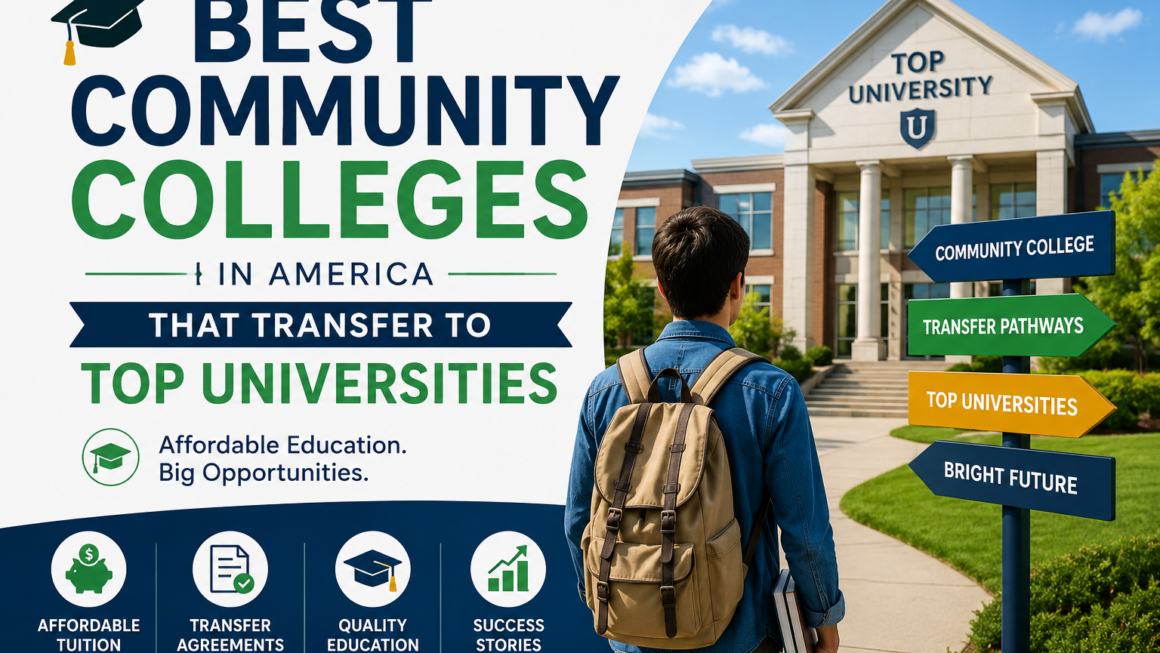
Let’s be completely honest: the price tag on a four-year college degree these days is absolutely insane. Staring down six figures of student loan debt before you even land your first entry-level job is enough to make anyone second-guess the traditional university route. Because of this, starting your higher education journey at a local two-year school is no longer looked at as a backup plan—it is officially a brilliant, hyper-strategic financial cheat code. Many students are completely shifting their perspective, treating these affordable hubs as a direct launchpad to elite, world-class institutions. To help you navigate this game-changing academic shortcut, mystudynest has put together an exhaustive guide highlighting the absolute best community colleges for transfer in the United States. If you play your cards right, you can save a mountain of cash on general education requirements and still graduate with a prestigious degree from a top-tier university.
Getting a handle on the exact mechanics of how to transfer from community college to university portals smoothly requires more than just enrolling in random classes and hoping for the best. It takes an intentional approach, a solid understanding of local credit laws, and an active plan right from your very first semester.
Why Starting at a Community College is an Absolute Cheat Code
For a long time, there was a weird, outdated stigma around two-year colleges. People assumed they were only for students who didn’t get great grades in high school. Today, that myth is completely dead. The smartest students in the room are choosing this path on purpose.
When you dive into the data regarding community college transfer rates, you quickly realize that top-tier four-year universities actively love taking in community college students. Why? Because you have already proven that you can handle real, college-level workloads. You aren’t a gamble for their admissions teams anymore.
- Massive Savings: You can drastically cut down your tuition costs and easily save up to $60,000 or more on your degree.
- Real Classrooms: You get actual face-to-face time with real professors in small rooms, instead of being ignored by Teaching Assistants (TAs) in giant lecture halls.
- Work-Life Balance: The flexible class schedules make it super easy to keep a part-time job or lock in local internships.
- A Fresh Start: It offers a total academic reset button, completely wiping out a bad high school track record.
Beyond the massive financial relief, starting at a two-year institution gives you an academic clean slate. If your high school transcripts were a total mess, nobody at UCLA, UVA, or NYU is going to care about your old teenage grades if you show up with a pristine 3.9 GPA from an accredited community college. It is your ultimate chance to completely reset your record and unlock doors that were previously locked tight.
The Top Community Colleges with Incredible Transfer Track Records
Not all community colleges are created equal. Some schools have worked tirelessly to build direct, rock-solid pipelines into the most competitive public and private universities in the nation. If your primary goal is to pivot into an elite four-year school, you want to attend a two-year campus that focuses heavily on transfer pipelines.
Here is a breakdown of the best community colleges in America that consistently send waves of students to top-ranked universities every single year.
1. Santa Monica College (SMC) – California
If you want to wear the iconic blue and gold of UCLA or walk through the historic gates of UC Berkeley, SMC is where you need to be. Based right by the coast in southern California, this campus is the undisputed champion when it comes to packing the University of California (UC) system with transfer students year after year.
- Primary Transfer Targets: UCLA, UC Berkeley, University of Southern California (USC), UC San Diego.
- The Secret Sauce: The transfer center at SMC is honestly on another level. They throw massive college fairs right on campus and have advisors who sit down with you to map out your semester lines so they fit exactly what top universities look for. It’s easily the most reliable shortcut for a clean community college to UC transfer without wasting any credits.
2. De Anza College – California
Tucked away in Cupertino, California—right in the beating heart of Silicon Valley—De Anza College is an absolute powerhouse for anyone looking to major in STEM, Computer Science, or Business.
- Primary Transfer Targets: Stanford University, UC Berkeley, UCLA, San Jose State University.
- The Secret Sauce: Because of its prime location, De Anza maintains deep ties with elite tech companies and nearby research universities. Their engineering and mathematics departments are uniquely rigorous, ensuring that when you transition to a highly competitive four-year environment, you won’t fall behind.
3. Northern Virginia Community College (NOVA) – Virginia
NOVA is one of the largest community colleges in the entire country, and it serves as the ultimate gateway to the elite public universities located across the state of Virginia.
- Primary Transfer Targets: University of Virginia (UVA), College of William & Mary, Virginia Tech, George Mason University.
- The Secret Sauce: NOVA has an incredible, structured pathway system known as the ADVANCE program with George Mason University, alongside an ironclad GAA (Guaranteed Admissions Agreement) with UVA. If you hit their specific GPA milestones, your acceptance letter to these world-class public schools is legally guaranteed.
4. Valencia College – Florida
Located in Orlando, Florida, Valencia College is nationally recognized for its exceptional graduation and transfer success rates. It handles the transition process with an incredible level of structure.
- Primary Transfer Targets: University of Central Florida (UCF), University of Florida (UF), Florida State University (FSU).
- The Secret Sauce: Valencia runs a legendary program called “DirectConnect to UCF.” The second you sign up for this pathway at Valencia, you are given a clear roadmap that grants you automatic, guaranteed admission to UCF once you wrap up your associate degree.
5. Miami Dade College (MDC) – Florida
MDC is an absolute massive cultural and academic powerhouse in South Florida. It has transformed from a local commuter school into an incredible launchpad that sends high-achieving students to both elite state universities and Ivy League institutions.
- Primary Transfer Targets: University of Miami, University of Florida, Columbia University, Cornell University.
- The Secret Sauce: MDC features an elite “Honors College” track. Students inside this track receive specialized mentorship, rigorous seminar-style classes, and dedicated transfer advisors who know exactly how to prep an application for highly selective four-year institutions.
Quick Comparison: Top Transfer Hubs at a Glance
| Community College Campus | Location | Primary Elite Partners | Key Advantage |
| Santa Monica College | California | UCLA, UC Berkeley, USC | Highest number of UC system transfers |
| De Anza College | California | UC Berkeley, Stanford | Rigorous STEM courses and tech links |
| Northern Virginia CC | Virginia | UVA, William & Mary | Guaranteed entry paths into state schools |
| Valencia College | Florida | UCF, University of Florida | DirectConnect path eliminates guesswork |
| Miami Dade College | Florida | University of Miami, Ivies | Dedicated honors program for elite spots |
The Secret Weapon: Articulation Agreements & Guaranteed Pathways
If you want to know how to transfer from community college without throwing away hard-earned credits or wasting an extra year of your life, you need to understand the concept of articulation agreements.
An articulation agreement is essentially a formal, legal contract between a two-year community college and a four-year university. This contract explicitly states, “If a student takes Class X at the community college, it will count perfectly as Class Y at our university.” Without these agreements, you run the massive risk of a university rejecting your credits, forcing you to pay for and retake the exact same classes all over again.
Many states have taken this a step further by establishing guaranteed transfer admission pathways. These programs remove all the terrifying guesswork from the admissions process.
The California TAG Program
In California, six UC campuses participate in the Transfer Admission Guarantee (TAG) program. If you maintain a specific GPA (usually anywhere between a 3.0 and a 3.4 depending on your major) and complete your required prerequisite courses, you are guaranteed a spot at places like UC Davis, UC Irvine, or UC Santa Barbara. While ultra-elite campuses like UCLA and UC Berkeley don’t participate directly in TAG, they have alternative programs like the Transfer Alliance Program (TAP) that give community college honors students a massive, unfair advantage during the selection process.
The Power of 2+2 Programs
Many states across America run on a structural “2+2 model.” Under this setup, your academic path is completely laid out for you. You spend your first two years hitting specific targets to earn your Associate of Arts (AA) or Associate of Science (AS) degree, and then you automatically step into your junior year at a partner university. This allows you to walk away with a prestigious bachelor’s degree at a fraction of the traditional cost.
Can You Really Transfer From a Community College to the Ivy League?
One of the most frequent questions students look up is whether it is actually possible to execute a transfer from community college to ivy league schools or elite private institutions like NYU, Stanford, and University of Chicago.
The short answer? Absolutely, yes.
In fact, some Ivy League schools actively seek out non-traditional transfer students because they bring incredible maturity, unique perspectives, and diverse life experiences to their campuses. However, the strategy for elite private transfers looks completely different than a standard state-school pathway:
- Columbia University: Columbia features the School of General Studies (GS), which is specifically designed for non-traditional students who have taken a break in their education or are transferring from two-year programs. It boasts some of the highest transfer acceptance rates among elite private institutions.
- Cornell University: Cornell has specific land-grant colleges within its university system (like the College of Agriculture and Life Sciences) that maintain official transfer options with specific community colleges throughout New York state.
- Princeton and Yale: Both of these legendary schools have recently expanded their transfer admission spots, focusing heavily on community college graduates and military veterans.
To catch the eye of an Ivy League admissions officer while attending a community college, a high GPA isn’t enough. You need to become a leader on your campus. Join the Phi Theta Kappa (PTK) honors society, launch a student club, participate in undergraduate research with your professors, or lead impactful community service projects. You want your application narrative to scream that you have completely outgrown the two-year environment and are fully prepared to dominate an elite academic playground.
Your Step-by-Step Action Plan for a Flawless University Transfer
If you want to pull this strategy off perfectly, you cannot afford to drift through your semesters aimlessly. You need a dedicated, tactical approach right from day one. Use this step-by-step checklist to ensure you stay on track.
Step 1: Declare Your Intent Early
The moment you walk onto your community college campus for orientation, make a beeline for the transfer counseling office. Tell your advisor exactly which associate degree transfer options you are targeting. Do not let them just hand you a generic class list. You need to ensure that every single class you enroll in satisfies the specific general education and major prerequisites of your target four-year destination.
Step 2: Obsess Over Your Core Prerequisites
A common mistake students make is focusing solely on their overall GPA while ignoring their major-specific prerequisites. If you want to transfer into an elite Business or Engineering program, universities care significantly more about how you performed in Calculus, Accounting, and Physics than they do about your introductory electives. Finish these core foundational blocks early and aim for nothing less than an “A.”
Step 3: Build Real Relationships with Your Professors
At a massive four-year university, your introductory classes might have 300 students packed into a giant lecture hall, and your work will mostly be graded by a Teaching Assistant (TA). At a community college, your classes will likely have 25 to 30 people, and you will be taught directly by the professor.
Use this to your advantage. Show up to their office hours, ask smart questions, and build genuine academic bonds. When it comes time to apply to your dream university, you will need glowing letters of recommendation. A detailed, highly personal letter from a community college professor who truly knows your work ethic is worth its weight in gold.
Step 4: Track Deadlines and Transfer Portals Like a Pro
Transfer application deadlines do not always match up with standard freshman timelines. For example, the application window for the University of California system opens up nearly a year in advance during the fall semester. Set up a digital calendar, map out your submission dates, keep track of any required application fees, and make sure your official transcripts are sent out way ahead of schedule.
Conclusion: Your Degree, Just Way Smarter
At the end of the day, your final bachelor’s degree diploma is only going to feature the name of the university you graduate from. It does not come with an asterisk stating that you spent your first two years saving money at a local community college.
By strategically leveraging the best community colleges for transfer, optimizing your credit pathways, and maintaining an excellent GPA, you can effectively bypass the massive student loan crisis. You get the exact same elite education, the exact same prestige, and the exact same career opportunities—all while keeping your financial future completely intact.
Stay laser-focused on your long-term vision, plan out your semesters with care, and remember that mystudynest is always right here to back you up with the ultimate advice for your academic journey. Go make it happen!