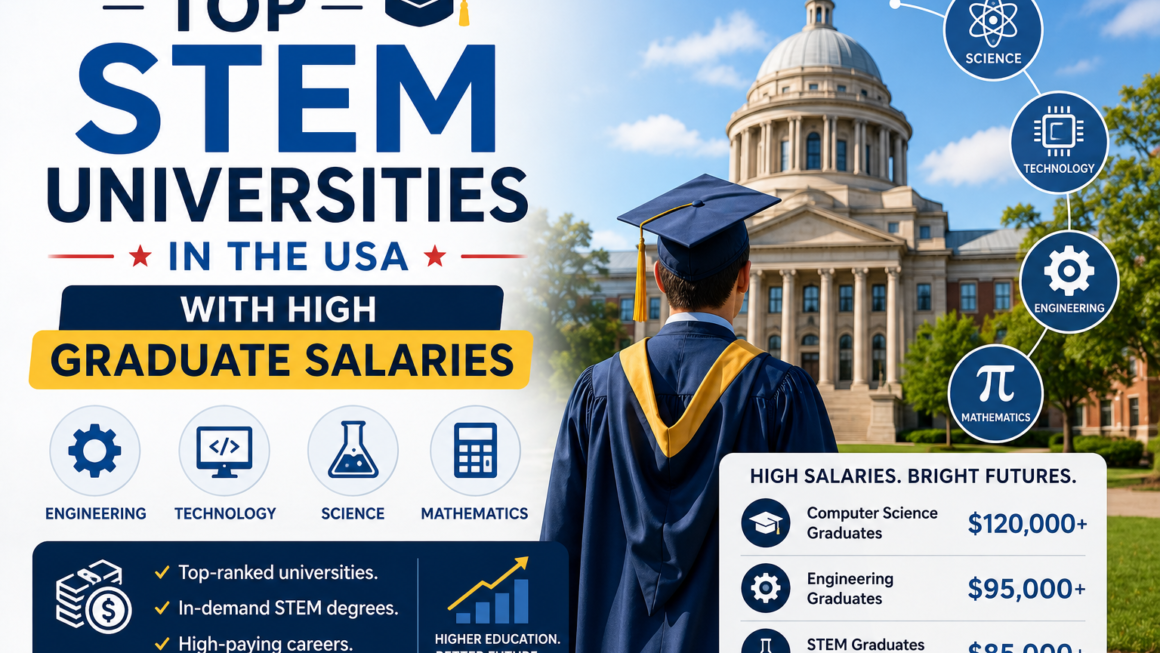
When you look at the current job market, one thing becomes crystal clear: the tech and engineering sectors are completely driving the global economy. If you want to future-proof your career and land a massive paycheck right out of school, focusing your higher education on Science, Technology, Engineering, or Mathematics is the single best move you can make. However, picking the right school isn’t just about finding a campus with cool labs or pretty buildings. It is about return on investment (ROI).
You basically need to pinpoint the exact campuses that maintain deep corporate connections that help you step straight into heavy paychecks. To make this decision a whole lot easier for you, mystudynest has built a fully detailed breakdown tracking down the absolute best STEM universities in the USA that excel at launching high-achieving grads. By matching your long-term academic targets with the correct school, you can effortlessly access the highest paying STEM degrees and establish solid financial stability right after graduation.
Figuring out the true value of different STEM career opportunities means looking well beyond popular university logos. It comes down to looking closely at average starting offers, real corporate tie-ups, and how aggressively a university helps its grads transition into major corporate roles.
The Reality of the STEM Paycheck: Why the School Name Matters
Let’s be real for a second—not all engineering or computer science degrees carry the same weight on a resume. A software engineering degree from a local, unranked college is great, but that exact same degree from an elite tech hub completely changes the game. Tech giants, massive hedge funds, and aerospace firms don’t just post jobs randomly on LinkedIn; they build exclusive pipelines into specific target universities.
When you study the latest data for highest graduate salaries by major, you notice a massive divide. High-ranking STEM academies don’t just teach you how to code or calculate complex fluid dynamics. They place you directly in front of recruiters from Apple, Google, NVIDIA, and SpaceX.
- Quick Path to Six Figures: Average starting packages frequently cross the $90k mark right away.
- Built-in Corporate Pipelines: You get priority access via exclusive on-campus recruitment drives.
- Premium Undergraduate Research: Early exposure to huge tech innovations and major federal grants.
- The Power of Elite Alumni: Direct mentorship lines stretching straight through Silicon Valley and Wall Street.
Opting for an institution that heavily dominates in best engineering programs in the US gives you a serious leg up throughout your entire working life. Having access to that specific network acts like an unwritten professional shortcut. It opens doors for major internal promotions and connects you directly with investors willing to fund your startup ideas before your resume even hits a standard HR desk.
The Elite Powerhouses: Top STEM Universities for Maximum Salaries
If your goal is to land an eye-popping starting salary package, these are the heavy hitters you need to look at. These universities consistently top the charts for graduate compensation across computing, aerospace, biotechnology, and quantitative finance.
1. Massachusetts Institute of Technology (MIT)
Located in Cambridge, Massachusetts, MIT is the undisputed global gold standard for technical education. It isn’t just a university; it is an economic engine.
- Primary Career Paths: Quantitative Trading, Artificial Intelligence, Aerospace Engineering, Biotech Research.
- Salary Vibe: Graduates routinely command starting base salaries clear of $110,000, with top computer science and data science majors pulling in massive sign-on bonuses.
- Why It Wins: MIT’s focus on intense, hands-on problem solving means companies don’t need to train you when you get hired. You are ready to build from your very first afternoon on the job.
2. California Institute of Technology (Caltech)
Caltech is a tiny, hyper-selective powerhouse based in Pasadena, California. With a microscopic student body and an intense focus on pure science and space exploration, it produces some of the sharpest minds on earth.
- Primary Career Paths: Astrophysics, Quantum Computing, Deep Tech Research, Robotics.
- Salary Vibe: Because of the heavy research focus, many graduates jump straight into cutting-edge R&D roles or elite tech firms with starting compensation packages that easily break six figures.
- Why It Wins: Caltech manages the Jet Propulsion Laboratory (JPL) for NASA. The level of prestige attached to undergraduate research here is virtually unmatched anywhere else in the world.
3. Stanford University
Sitting right in the geographical heart of Silicon Valley, Stanford is the ultimate launchpad for tech founders, venture capitalists, and software engineers. It is arguably the most influential top computer science schools hub on the planet.
- Primary Career Paths: Venture Capital, Big Tech Engineering, AI Development, Startup Founding.
- Salary Vibe: Standard starting salaries for software developers coming out of Stanford hover around $115,000 to $130,000, not including equity packages that can turn into millions if a company blows up.
- Why It Wins: The proximity to Sand Hill Road (the capital of venture investment) means your classmates might literally be your future angel investors. It is an unmatched ecosystem for tech wealth.
4. Carnegie Mellon University (CMU)
Located in Pittsburgh, Pennsylvania, CMU boasts what many industry insiders consider the absolute best, most rigorous computer science undergraduate program in existence.
- Primary Career Paths: Machine Learning, Cyber Security, Game Design, Quantitative Devs.
- Salary Vibe: The School of Computer Science at CMU regularly reports average graduate starting salaries pushing past $120,000.
- Why It Wins: CMU was an early pioneer in artificial intelligence and robotics. When Wall Street firms or Silicon Valley labs need elite engineers who understand complex algorithms, CMU is the very first place they look.
5. Georgia Institute of Technology (Georgia Tech)
For students looking for an incredible return on investment without the private school price tag, Georgia Tech in Atlanta is an absolute dream option. It stands tall as one of the premier best public universities for STEM.
- Primary Career Paths: Civil Engineering, Mechanical Engineering, Data Analytics, Corporate Tech Management.
- Salary Vibe: Out-of-state and in-state graduates alike see a massive financial return, with average engineering starting salaries starting around $85,000 to $95,000.
- Why It Wins: Georgia Tech maintains a massive co-op and internship program. Most students graduate with a full year of real-world corporate experience already under their belt, making them instant targets for major hiring managers.
Quick Look: Top STEM Schools Compared by ROI
| University Name | School Type | Top Industry Sector | Average Starting Salary Range |
| MIT | Private | Big Tech / Quant Finance | $110,000 – $135,000+ |
| Stanford | Private | Silicon Valley Startups / AI | $115,000 – $140,000+ |
| Carnegie Mellon | Private | Machine Learning / Robotics | $105,000 – $130,000+ |
| Caltech | Private | Aerospace / Deep R&D | $100,000 – $125,000+ |
| Georgia Tech | Public | Enterprise Tech / Aerospace | $85,000 – $105,000+ |
High-Income Majors: Decoding the Best STEM Degrees
If you want to maximize your early-career income, your specific choice of major within the STEM umbrella matters immensely. While all these fields pay well compared to humanities or arts, certain tracks offer eye-watering financial rewards immediately after graduation.
When you look into careers in demand for STEM, the software and data sectors are currently leading the pack by a wide margin.
The Rise of Quantitative Finance and Data Science
If you have an insane talent for mathematics and statistics, you don’t just have to work in a lab. The highest-paying sector for math geniuses right now is Wall Street. High-frequency trading firms and hedge funds actively recruit math, physics, and computer science majors for “Quant” roles.
These elite firms hire technical minds to build heavy math frameworks and trading codes that run market moves in fractions of a second. Because the work directly influences billions of dollars, the initial pay scales and bonuses for these roles easily climb past the $200k mark.
Aerospace and Hardware Engineering
With the commercialization of space and the global race for advanced semiconductor chips, hardware engineers and aerospace experts are seeing a massive surge in market value. Specialized programs focused on top engineering universities provide direct access to defense contractors, satellite companies, and chip makers like Intel and AMD.
How to Get Recruited Into High-Paying STEM Roles
Getting a seat at a great university is only half the battle. If you want to walk across the graduation stage with a massive corporate contract waiting for you, you need to execute a clear professional strategy throughout your undergraduate years.
1. Build a Flawless GitHub and Portfolio
In the technical world, your degree is nice, but your portfolio is what actually clinches the deal. If you are a developer, your GitHub profile needs to show clean, active code, open-source contributions, and complex personal projects. If you are a mechanical engineer, you need a digital portfolio highlighting real objects you have designed, 3D modeled, and physically built.
2. Dominate the Career Fair Ecosystem
Do not wait until your senior year to step into a college career fair. Go during your freshman year just to practice speaking with recruiters. Learn what they look for in an ideal candidate, pick up their business cards, and understand their timeline for summer internship applications. Securing a premium sophomore or junior summer internship is the most common way to land a full-time return offer before your final year even begins.
3. Master the Technical Interview Process
STEM interviews are notoriously brutal. Coding positions often force you to break down difficult logic puzzles right on a whiteboard while a panel evaluates you under a clock (typical LeetCode environments). Engineering tracks will pull apart your absolute baseline knowledge of materials and system dynamics under stress. Make sure you set aside hours every single week to practice talking through these structural challenges so it feels natural when you are on the spot.
Balancing the Equation: Tuition Cost vs. Future Salary
When planning out your college journey, you have to run the numbers like a business. If you take on $250,000 in debt to attend an elite private school, your starting salary needs to justify that massive monthly loan payment. This is why exploring affordable STEM degrees at elite public universities can sometimes be the smarter financial play.
Schools like UC Berkeley, UIUC (University of Illinois Urbana-Champaign), and University of Michigan offer elite technical programs that match private Ivy League schools in quality, but at a fraction of the cost for state residents. Always calculate the “Net Present Value” of your education—look at what you will actually pay out of pocket versus what your projected post-grad income looks like over the first five years.
Conclusion: Set Yourself Up for Ultimate Success
At the end of the day, chasing a career in STEM is one of the smartest investments you can make in yourself. The mental toolset you pick up—things like system-level coding, heavy mathematical logic, and step-by-step troubleshooting frameworks—carries a high premium that simple automated platforms can’t replicate out of the box.
By choosing a university that matches your ambition, targeting the highest paying STEM degrees, and aggressively building your corporate network early on, you can completely bypass the early-career financial struggles that trap so many young professionals.
Keep your standards high, focus on your technical skills, and remember that mystudynest is always right here to provide you with the sharpest roadmaps for your educational future. You’ve got this!